

The Application of Drop-Out Fuses in Electrical Distribution Systems
The drop-out fuse, or expulsion-type fuse cutout as it is also called, is a key and widely used protective device in medium-voltage overhead distribution networks. These networks usually operate between 11kV and 33kV. This device works two ways: it protects the circuit, and it gives a clear sign that the circuit is disconnected.
Its main job is to keep distribution transformers, capacitors and feeder sections safe. It stops damage from too much current — the kind that comes from short circuits or constant overloading. The way it works is simple and effective. Inside a porcelain or polymer insulator, there is a fuse link. This link is made to carry normal electric loads.
When a fault causes current to go over a set level for a certain time — the level and time are fixed beforehand — the fuse element melts. This melting creates an electric arc. The arc makes the pressure inside the fuse tube jump up. The high pressure pushes out gas, which puts out the arc right away and shuts off the circuit.
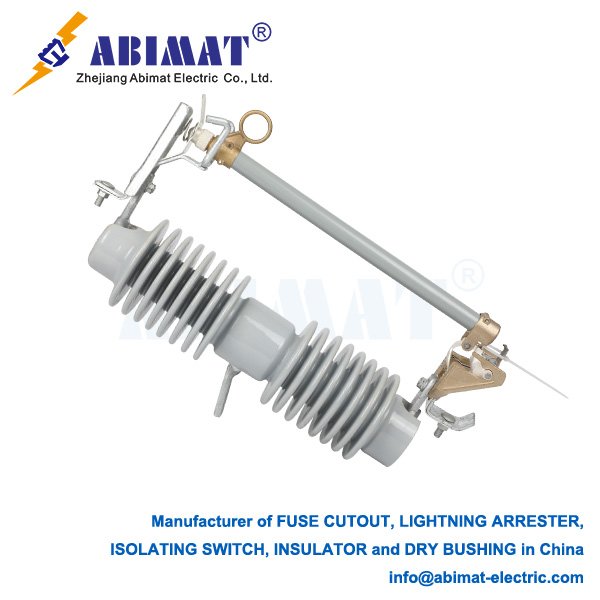
One important mechanical feature is what people call the “drop-out” action. After the fuse works, the fuse carrier — it is hinged at the top — lets go by itself and swings down. This movement is easy to see. It tells everyone the circuit has been cut off, making things safer for the workers who fix the lines. This clear break is vital when crews need to do maintenance.
It has big advantages. It does not cost much, it works reliably, and it needs almost no upkeep. Unlike enclosed switches, it shows a clear gap when disconnected — that is a safer choice for isolating parts of the system. Workers can also use a hot stick to operate it by hand. This lets them safely open or close the circuit, whether for switching needs or to isolate a transformer.
All in all, the abimat drop-out fuse is still a backbone of protection for overhead distribution systems. It combines reliable overcurrent protection, a clear visual break, the ability to switch by hand and low cost. These qualities make sure it stays an essential part of keeping power networks safe and working well.